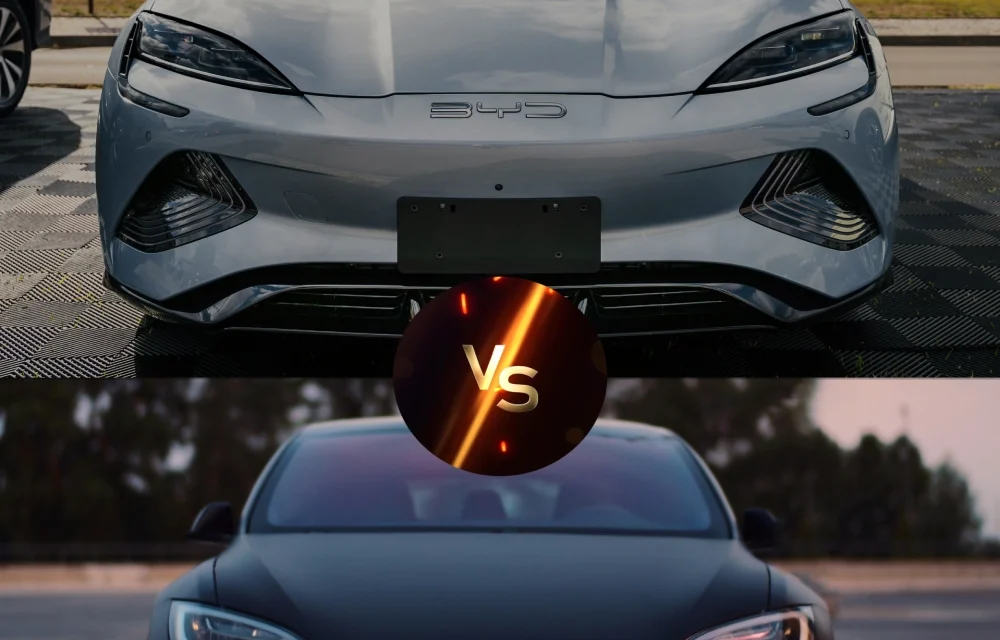
In the high-stakes world of electric vehicles, a dramatic shift is occurring. BYD (Build Your Dreams), once considered a distant challenger to Tesla’s dominance, has decisively surged ahead to become the world’s leading EV manufacturer in 2025. This transformation represents more than just changing sales figures—it signals a fundamental realignment in the global automotive industry.
The Numbers Don’t Lie: BYD’s Stunning Ascendancy
The first quarter of 2025 marked a watershed moment as BYD delivered 416,388 passenger battery electric vehicles (BEVs), significantly outpacing Tesla’s 336,681 units. This wasn’t a one-time occurrence—it followed BYD’s breakthrough in Q4 2024, when it delivered 595,413 BEVs compared to Tesla’s 495,570.
In fact, BYD’s Q1 2025 performance was 23.7% higher than Tesla’s, representing an advantage of 79,707 more BEV sales globally. When considering all plug-in vehicles (including hybrids), BYD’s lead becomes even more staggering at 192.9% more sales than Tesla.
What was once a neck-and-neck race has evolved into a clear lead. Market analysts at Counterpoint Research now project BYD will capture 15.7% of the global EV market in 2025, compared to Tesla’s 15.3%, officially making BYD the world’s leading BEV brand for the first time.
Strategic Advantages Fueling BYD’s Rise
Price Leadership in Emerging Markets
While Tesla concentrates primarily on North America and Europe, BYD has aggressively expanded in Latin America and Southeast Asia—regions where Tesla maintains limited presence. BYD’s strategy of offering more affordable vehicles than Tesla in at least 10 countries outside the West has proven highly effective.
The price gap is substantial: The 2025 BYD Seal starts around $28,000-$35,000, while the comparable Tesla Model 3 begins at $38,990-$45,000. BYD also offers more entry-level options, including compact models like the Dolphin, priced under $20,000 in some markets.
Technological Innovation
BYD’s technological advancements have been equally impressive, erasing Tesla’s former advantage:
In March 2025, BYD unveiled revolutionary battery charging technology that adds 250 miles of range in just five minutes—surpassing Tesla’s Superchargers, which take 15 minutes to add 200 miles.
This system features a 1,000-kW ultra-fast charging capability utilizing 10C charging rate batteries, far outpacing Tesla’s current Supercharger offerings. The technology can deliver 400 km (250 miles) of range in just 5 minutes, setting a new industry benchmark.
Vertical Integration: The BYD Manufacturing Advantage
A key factor in BYD’s ascendancy is its vertical integration—controlling everything from batteries and motors to electronic systems through its subsidiaries. This end-to-end control provides significant cost advantages and operational efficiencies, enabling BYD to offer competitively priced vehicles without sacrificing margins.
Tesla’s Mounting Challenges
Tesla’s struggles extend beyond BYD’s rise. The company faces:
In Europe, Tesla’s sales have plummeted, with February figures showing a 40% drop compared to the same month in 2024, according to the European Automobile Manufacturers’ Association.
In China, Tesla claimed only 6.1% of the new energy vehicle market in 2024, despite reaching record high shipments. BYD, meanwhile, commanded a dominant 32% share.
Industry analysts attribute Tesla’s stagnant sales to its aging model lineup and suggest that CEO Elon Musk’s political activism may have alienated long-time loyal customers.
Global Expansion: BYD’s Growing Footprint
BYD’s international ambitions continue accelerating, with the company pledging to boost total shipments by nearly 30% this year and nearly double its overseas deliveries to more than 800,000 vehicles, according to statements from founder and CEO Wang Chuanfu.
In Europe, where Tesla struggles with declining sales, BYD is gaining ground and constructing two manufacturing plants, with exploration underway for a third facility after factories in Hungary and Turkey.
Financial Milestone: Revenue Supremacy
BYD’s dominance extends beyond unit sales to financial performance:
In 2024, BYD recorded revenues of 777 billion yuan ($107 billion), surging past Elon Musk’s Tesla ($97.7 billion) in annual sales. This represents a 29% jump from the previous year on deliveries of 4.27 million cars (including hybrids).
Looking Forward: The EV Landscape in 2025
As we progress through 2025, several trends appear clear:
- BYD’s leadership position is likely to strengthen as its global manufacturing footprint expands
- Price competition will intensify, particularly in emerging markets where BYD has established a significant head start
- Technological innovation will accelerate, with charging speed and battery efficiency becoming key competitive factors
- Tesla will need to address its aging model lineup and consider more affordable options to compete globally
BYD has become the people’s champion in the EV race—making electric mobility accessible to a broader audience globally. While Tesla still maintains advantages in charging infrastructure and software, BYD’s trajectory suggests these gaps will continue narrowing through 2025 and beyond.
For consumers worldwide, this intensifying competition delivers clear benefits: more affordable electric vehicles, faster technological advancement, and an accelerated transition to sustainable transportation.