Powering the Haul: China’s Ambitious Plans for the Electric Trucking Industry (2025)
Executive Summary
As the world grapples with decarbonizing its transport sectors, China is aggressively steering its massive road freight industry towards an electric future. Far beyond passenger cars, Beijing’s ambitious plans for New Energy Commercial Vehicles (NECVs), particularly electric and hydrogen fuel cell trucks, are set to revolutionize logistics, reduce emissions, and solidify China’s global leadership in the broader New Energy Vehicle (NEV) domain. Driven by stringent environmental targets, a quest for energy security, and the pursuit of technological supremacy, China is deploying a multi-faceted strategy. This includes robust policy support, significant investment in diverse technological pathways like battery electric trucks (BEVs), rapid battery swapping systems, megawatt charging infrastructure, and hydrogen fuel cell electric vehicles (FCEVs). As of 2025, the momentum is palpable, with major manufacturers rolling out innovative e-trucks and pilot programs scaling up, though significant challenges in infrastructure and cost remain on the long road ahead.
1. The ‘Why’: Driving Forces Behind China’s Electric Trucking Revolution
Meeting Ambitious Decarbonization Goals & Improving Air Quality
The road freight sector is a cornerstone of China’s economy but also a major contributor to its carbon emissions and air pollution, especially in industrial zones and urban centers. Heavy-duty trucks, in particular, have an outsized environmental impact. China’s “Dual Carbon” pledge – to peak CO2 emissions before 2030 and achieve carbon neutrality before 2060 – makes the electrification of this sector a non-negotiable imperative. Reducing tailpipe emissions from millions of trucks is critical for improving air quality for its citizens and meeting these national climate commitments.
Bolstering Energy Security by Reducing Oil Dependence
China is the world’s largest importer of crude oil, and its trucking industry is a significant consumer of diesel fuel. Transitioning to domestically produced electricity and, increasingly, green hydrogen to power its commercial fleet aligns perfectly with national strategies to enhance energy security and reduce vulnerability to volatile global oil markets. This shift supports a more self-reliant energy ecosystem.
Enhancing Logistics Efficiency & Aiming for Lower Total Cost of Ownership (TCO)
While the upfront cost of electric and hydrogen trucks can be higher than their diesel counterparts, the potential for lower Total Cost of Ownership (TCO) over the vehicle’s lifespan is a major draw. This comes from significantly reduced “fuel” costs (electricity or hydrogen vs. diesel) and lower maintenance expenses due to fewer moving parts in electric powertrains. As battery prices continue to fall and e-truck technology matures, favorable TCO is expected to drive wider adoption by logistics companies, boosting overall sector efficiency.
Cementing Global Leadership in New Energy Vehicle (NEV) Technology
Having already established a dominant position in the global electric passenger car market, China is keen to extend this leadership to commercial vehicles. Success in electrifying its complex trucking industry will showcase its technological prowess, manufacturing capabilities, and ability to implement large-scale industrial transitions. This strengthens its position as a global leader in the entire NEV supply chain, from batteries and fuel cells to vehicle production and smart logistics solutions.
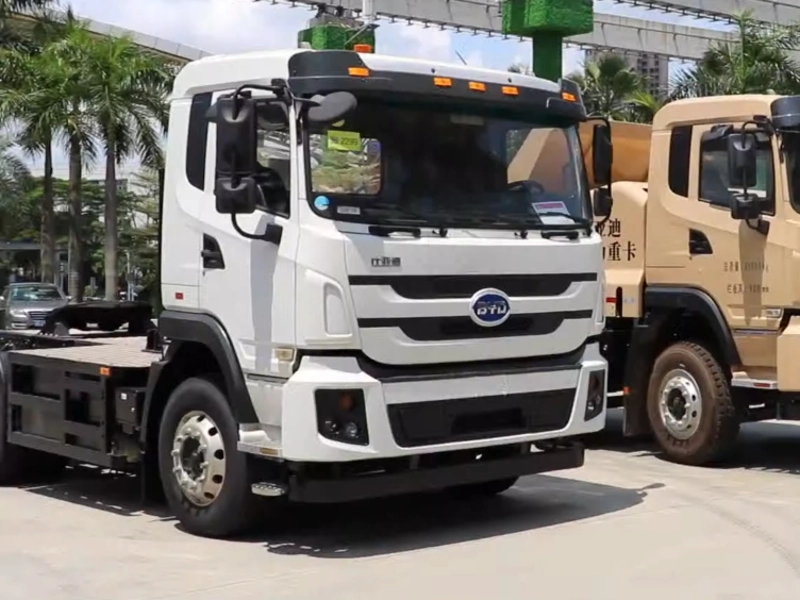
2019 BYD 8TT Shenzhen Chinese EV Trucks
2. Policy & Ambition: Government Initiatives Steering the Charge
National Strategies and “Green Freight” Mandates
China’s “New Energy Vehicle Industry Development Plan (2021–2035)” serves as a high-level blueprint, guiding the comprehensive integration of NEVs across all vehicle segments, including commercial trucks. Various ministries have issued directives and “Green Freight” initiatives aimed at accelerating the adoption of NEV trucks in specific regions and applications. As of early 2025, policies continue to encourage the replacement of older, more polluting diesel trucks with new energy alternatives, especially in key economic zones and urban areas.
Financial Incentives: Subsidies, Tax Breaks, and Support (Past & Present Focus)
Historically, direct purchase subsidies played a crucial role in kickstarting the NEV truck market. While these direct subsidies for vehicle purchase have been scaled back or evolved (as seen with passenger NEVs), government support continues through other mechanisms. These may include operational subsidies for certain routes or types of NEV trucks, tax exemptions or reductions (like the vehicle purchase tax exemption for NEVs, which has been extended), and funding for research and development into core technologies like batteries and fuel cells. Local governments also often provide their own incentives, such as free license plates or preferential access for NEV trucks in urban areas.
Pilot Zones & Specific Application Scenarios
China has designated numerous cities and regions as pilot zones for NEV adoption in commercial applications. These initiatives often target specific scenarios where electrification offers clear benefits, such as:
- Ports and Terminals: Electric tractors, drayage trucks, and other specialized vehicles.
- Mining and Construction Sites: Heavy-duty electric dump trucks and other off-road vehicles, often utilizing battery swapping.
- Urban Logistics and Sanitation: Electric light and medium-duty trucks for last-mile delivery, waste management, and street cleaning.
- Short-Haul Intercity Freight: Increasingly common for BEV trucks with established charging/swapping routes.
These pilots help refine technology, develop operational models, and build out necessary infrastructure in controlled environments before wider rollout.
Setting Targets: Adoption Goals for NEV Trucks
While national overarching NEV penetration targets (like the ~40.9% NEV share of all vehicle sales in China in 2024, with sights on ~48-50% for 2025) often group passenger and commercial vehicles, specific targets for commercial vehicles, especially heavy-duty ones, are also part of regional and sectoral plans. For instance, Shanghai aimed for 10,000 FCEVs (many expected to be commercial) and 70 hydrogen stations by 2025. The national goal of 50,000 FCEVs by 2025 also heavily implies commercial vehicle use. These targets drive focused investment and policy execution.
3. Technological Pathways: Diverse Solutions for Diverse Needs
China is pursuing a pragmatic, multi-technology approach to electrifying its trucking industry, recognizing that no single solution fits all applications.
Battery Electric Trucks (BEV): Dominating Urban & Regional Haulage
BEVs are the most mature and widely adopted NEV truck technology, particularly for light and medium-duty trucks in urban logistics, sanitation, and short-to-medium haul applications. Advances in LFP (Lithium Iron Phosphate) battery technology have made BEVs more affordable, durable, and safer. Battery pack sizes are increasing, enabling longer ranges, and manufacturers are optimizing vehicle designs for electric powertrains.
Battery Swapping: A Game Changer for Heavy-Duty BEV Uptime
For heavy-duty BEVs, where long charging times can significantly impact operational efficiency, battery swapping has emerged as a key enabling technology in China. This allows trucks to exchange depleted batteries for fully charged ones in as little as 3-5 minutes. Several companies, including giants like CATL (with its Qiji Energy solution), Aulton New Energy, State Grid, and GCL Energy Tech, are actively building out battery swapping station networks, particularly for heavy trucks operating on fixed routes or in closed-loop scenarios like ports and mines. Standardization of battery packs and swapping interfaces is a key focus to ensure interoperability.
Megawatt Charging: Powering Up for Quick Turnarounds
Alongside battery swapping, China is also investing heavily in Megawatt Charging System (MCS) technology for trucks. MCS aims to deliver charging power of 1MW or more, drastically reducing charging times for large battery packs. This is seen as crucial for enabling longer-haul BEV trucking and reducing dwell times at charging depots. The ChaoJi charging standard (co-developed by China and Japan) also supports high-power charging. Deployment of MCS is in its earlier stages in 2025 but is a strategic priority.
The Hydrogen Horizon: Fuel Cell Electric Trucks (FCEV) for Long Haul & Heavy Loads
Recognizing the limitations of current battery technology for very long-haul and extremely heavy payload applications, China has identified hydrogen FCEVs as a critical complementary pathway. FCEVs offer longer ranges and quicker refueling times compared to BEVs, making them suitable for demanding freight operations. Government plans include developing “hydrogen corridors” with refueling infrastructure along key trucking routes. Major cities and regions have set ambitious targets for FCEV deployment and hydrogen refueling station construction. While still in earlier stages of commercialization than BEVs, FCEV truck development and pilot deployments are accelerating, supported by significant R&D funding.
4. On the Road: Leading Manufacturers & Groundbreaking Innovations
Established Giants Embracing Electric: FAW Jiefang, Dongfeng, Sinotruk, Foton, JAC
China’s traditional commercial vehicle behemoths are all heavily invested in NEV trucks. FAW Jiefang, Dongfeng Commercial Vehicle, Sinotruk (CNHTC), Foton Motor (part of BAIC Group), and JAC Motors have extensive lineups of electric and, increasingly, hydrogen fuel cell trucks. They are leveraging their established manufacturing bases and sales networks while adapting to new energy powertrains. Many are involved in battery swapping and autonomous driving pilots.
Specialized & Emerging Players: SANY, Geely’s Farizon Auto, XCMG
Beyond the traditional players, companies like SANY Heavy Industry (known for construction machinery) have become significant players in electric heavy trucks, especially battery-swapping models for mining and port applications. Geely’s Farizon Auto is a dedicated commercial NEV brand with a diverse portfolio including electric light trucks, battery-swapping heavy trucks, and even methanol-powered trucks. XCMG is another major construction machinery company rapidly electrifying its range, including mining trucks.
“Smart” Trucks & Autonomous Driving Developments
The push for electrification is intertwined with the development of “smart” and autonomous trucks. Chinese companies like Inceptio Technology, Pony.ai (PonyTron), and TuSimple (though its China operations have evolved) are developing Level 3 and Level 4 autonomous driving solutions for logistics. These are often deployed on NEV truck platforms. As of 2025, large-scale deployments are underway in closed environments like ports (e.g., Shanghai, Tianjin) and on designated highways for “middle-mile” logistics, with companies like ZTO Express utilizing hundreds of autonomous trucks in partnership with tech providers.
Showcasing Innovation: Notable Electric/Hydrogen Truck Models & Technologies
Recent years have seen the launch of impressive models, such as FAW Jiefang’s J6P/J7 electric and hydrogen trucks, Dongfeng’s Chenglong series NEVs, Sinotruk’s Yellow River brand FCEVs, Farizon’s Homtruck (a concept for a smart, connected long-haul truck), and SANY’s battery-swapping dump trucks. The rapid deployment of standardized battery swap stations by CATL and others is a key ongoing innovation.
5. Overcoming Hurdles: Challenges on the Path to an All-Electric Fleet
Infrastructure Gaps: Charging, Swapping, and Hydrogen Refueling Networks
Despite rapid progress, building out a comprehensive, reliable, and economically viable nationwide energy infrastructure for millions of commercial NEVs is a colossal undertaking. Ensuring sufficient coverage of high-power chargers, battery swap stations (especially along key freight corridors), and hydrogen refueling stations remains a primary challenge.
The Cost Equation: Upfront Investment vs. Total Cost of Ownership (TCO)
The initial purchase price of electric and hydrogen trucks is still generally higher than diesel equivalents. While TCO can be favorable over time due to lower fuel and maintenance costs, convincing fleet operators (especially smaller ones) to make the larger upfront investment can be difficult without sustained incentives or innovative financing/leasing models (like Battery-as-a-Service).
Technical Limitations: Battery Weight, Range, and Payload Capacity for Heavy-Duty BEVs
For long-haul, heavy-duty BEVs, the sheer weight and volume of batteries required for adequate range can reduce payload capacity and impact efficiency. While battery energy density is improving, this remains a technical hurdle that FCEVs and battery swapping aim to mitigate.
Operational Realities: Charging Times, Route Planning, and Driver Adaptation
Integrating NEV trucks into existing logistics operations requires careful planning around charging/swapping/refueling times, route optimization, and driver training. Unforeseen delays can impact delivery schedules and overall fleet productivity.
Grid Impact and Renewable Energy Integration
The large-scale charging of electric truck fleets will place significant new demands on the electricity grid. Ensuring grid stability, managing peak loads, and, crucially, powering these trucks with renewable energy sources (to achieve true decarbonization) are vital long-term considerations.
Conclusion: China’s Electric Trucking Future – A Heavy Load, A Clear Direction
China’s ambition to electrify its vast trucking industry by 2025 and beyond is a monumental undertaking, central to its economic, environmental, and technological aspirations. The nation is not shying away from the scale of the challenge, employing a comprehensive strategy that combines strong policy direction, diverse technological pathways (BEV, battery swapping, FCEV, megawatt charging), and robust industry participation. While hurdles related to infrastructure, cost, and operational integration persist, the progress is undeniable and the commitment unwavering. The electrification of China’s road freight is set to profoundly impact global supply chains, accelerate NEV technology development, and offer a compelling blueprint for how a major economy can tackle the decarbonization of its heavy transport sector. The direction is clear, and the wheels are firmly in motion.
Reader Takeaways
- For Logistics & Fleet Operators in China (and those observing globally): The time to seriously evaluate and pilot New Energy Commercial Vehicles is now. Start with specific routes and applications where the TCO and operational benefits are clearest. Engage with battery swapping and BaaS providers to explore opex models.
- For Technology Developers & Suppliers (Global): China’s NEV truck market represents an immense opportunity for innovation in batteries (higher density, faster charging, lower cost LFP), fuel cell systems, power electronics, charging/swapping infrastructure, autonomous driving solutions, and fleet management software tailored for electric/hydrogen operations.
- For International Observers & Policymakers: China’s pragmatic, multi-technology approach and its emphasis on building out infrastructure in parallel with vehicle deployment offer valuable lessons. The focus on specific application scenarios for initial rollouts can also be a key learning for other nations looking to decarbonize their freight sectors.
- For Investors: The entire NEV trucking ecosystem in China, from advanced component manufacturing (batteries, fuel cells) and vehicle OEMs to energy infrastructure (charging, swapping, hydrogen) and smart logistics solutions, presents significant long-term growth avenues. However, given the rapid technological evolution and policy-driven nature of the market, thorough due diligence and an understanding of local dynamics are crucial.