
Going Global: The Top Chinese EV Brands Expanding Worldwide in 2025
Subtitle: How a Wave of Innovation and Ambition from the East is Reshaping Our Roads
Executive Summary
The global automotive industry is witnessing an unprecedented shift, and Chinese electric vehicle (EV) brands are firmly in the driver’s seat of this transformation. No longer confined to their vast domestic market, these companies are embarking on an ambitious global expansion drive that is gathering serious momentum in 2025. Fueled by intense domestic competition that has forged innovation and cost efficiencies, advanced battery technology and compelling product lineups, Chinese EV makers are increasingly challenging established automakers on the world stage. This article dives into the top Chinese EV brands leading this international charge, exploring their strategies, key export markets (including their growing presence in places like Australia), standout models, and the significant impact they are having on global EV adoption and the wider auto sector.
1. The Dragon Spreads Its Wings: Why Chinese EVs Are Going Global Now
Several potent factors are propelling Chinese EV brands onto the international stage with such vigour in 2025. It’s not just a trend; it’s a calculated and increasingly successful strategic push.
Saturated Domestic Market Driving Overseas Ambition
The Chinese domestic EV market, while the world’s largest, is also incredibly crowded and competitive. With hundreds of brands vying for market share, expanding overseas offers a crucial avenue for growth and a way to leverage the immense production capacities built up over the past decade. Think of it as a pressure valve releasing a torrent of innovation outwards.
Technological Edge and Competitive Pricing as Key Enablers
Chinese companies have become leaders in critical EV technologies, particularly in battery manufacturing (like BYD’s Blade Battery or CATL’s Qilin) and, increasingly, in smart vehicle systems. This tech prowess, combined with highly efficient manufacturing and supply chain control (especially for LFP batteries), allows them to offer feature-rich, high-performance EVs at prices that are often significantly more competitive than those from legacy automakers. This value proposition is a powerful door opener in many international markets.
Government Support and the “Going Out” Strategy
While direct subsidies might be evolving, the broader strategic support from the Chinese government for its NEV industry, including encouragement for international expansion (the “Going Out” strategy), remains a factor. This can involve support for R&D, facilitating international trade, and investing in global supply chain security.
Building Global Brand Recognition
For many Chinese brands, global expansion is also about building internationally recognized and respected automotive marques. Success in mature and discerning markets like Europe or Australia serves as a powerful validation of their quality, technology, and appeal, helping to shift outdated perceptions of Chinese manufacturing.
Multimedia Concept: Consider an infographic here showing a graph of China’s domestic EV sales growth vs. its EV export growth over the last 3-5 years.
2. Leading the Charge: Top Chinese EV Brands Making Global Waves in 2025
While many Chinese brands are testing international waters, a few are leading the pack in terms of scale, market penetration, and strategic intent. Here are some of the most prominent players in 2025:
1. BYD: From Domestic Titan to Global EV Powerhouse
BYD’s global expansion is arguably the most formidable. Having conquered its home market, BYD is rapidly entering regions across Europe (Germany, UK, Nordics, etc.), Southeast Asia (Thailand, Malaysia, Singapore), Australia, New Zealand, Latin America, and the Middle East. Their strategy involves launching a range of well-received models like the Atto 3 (Yuan Plus) compact SUV, the Dolphin hatchback, and the sleek Seal sedan. As of early 2025, BYD is not just exporting; it’s setting up manufacturing plants in countries like Thailand, Hungary (due to open in late 2025), and Brazil to localize production and navigate trade complexities. Their target of doubling overseas sales in 2025 to around 800,000 units underscores their aggressive global push.
2. Geely Holding Group (Leveraging Multiple Brands)
Geely employs a multi-brand strategy for global reach. While Volvo and Polestar already have a strong international presence built on their European heritage (now heavily influenced by Geely’s EV tech), the dedicated EV brand Zeekr is a key focus for premium global expansion. Zeekr has entered several European markets and has ambitious plans for further growth, including a confirmed launch in Australia with models like the Zeekr X (compact SUV) and the upcoming Zeekr 7X (mid-size SUV) slated for late 2025, aiming to challenge the Tesla Model Y. The Smart brand, co-owned with Mercedes-Benz and engineered by Geely, also produces its EVs in China for global export.
3. SAIC Motor (Primarily via MG)
SAIC Motor has achieved remarkable international success through its iconic British heritage brand, MG. MG has become a top-selling EV brand in several countries, including Australia, the UK, and parts of Europe and Asia, thanks to affordable and popular models like the MG4 EV, MG ZS EV, and the MG5 EV. SAIC’s strategy leverages MG’s established (though dormant for a while) brand recognition in these markets, combined with competitive Chinese manufacturing and EV technology. In 2024, MG sales in Europe alone surpassed 240,000 units.
4. Nio: Premium EVs and Unique Battery Swapping Ecosystem
Nio’s international strategy is focused on the premium segment and its unique selling proposition: battery swapping. It has established a presence in several European countries, including Norway, Germany, the Netherlands, Sweden, and Denmark, deploying its signature Nio Houses and Power Swap Stations. As of early 2025, Nio operates over 60 swap stations in Europe. With the recent launch of its more mainstream brand, **Onvo** (with the L60 SUV aimed at the Tesla Model Y segment), Nio hopes to achieve greater volume internationally while offering access to its established service and swapping infrastructure.
5. Great Wall Motor (GWM)
GWM is expanding internationally with its distinct sub-brands. Ora has gained traction in markets like Australia, the UK, Thailand, and parts of Europe with its retro-styled electric hatchbacks (e.g., Ora Good Cat/Funky Cat). The Wey brand is targeting premium segments with its advanced PHEVs in some regions, and Tank is bringing its rugged hybrid off-roaders to markets including Australia. GWM often partners with local distributors to build its presence.
6. Chery Automobile
As one of China’s largest vehicle exporters overall, Chery is making a significant push with its NEV offerings, often under its sub-brands **Omoda** and **Jaecoo**. The Omoda 5 EV is a key model being rolled out in Australia, Southeast Asia, Europe, and Latin America. Chery’s strategy often focuses on providing feature-rich vehicles at very competitive price points, appealing to budget-conscious buyers looking for modern design and technology.
7. Leapmotor (Accelerated by Stellantis Partnership)
Leapmotor’s global ambitions received a massive boost from its strategic partnership with automotive giant Stellantis, which acquired a stake and formed Leapmotor International. This joint venture aims to leverage Stellantis’s global distribution network and manufacturing footprint to sell Leapmotor EVs outside China. Europe is a key initial target, with models like the **C10 (SUV)** and **T03 (city car)**. Local assembly, like the plans for Malaysia starting in late 2025, is also part of the strategy to serve regional markets like ASEAN.
3. Strategies for Global Conquest: How Chinese Brands Are Tackling International Markets
Chinese EV brands are not just shipping cars; they are employing sophisticated strategies to win over global consumers.
Localized Product Offerings and Marketing
Successful brands are increasingly adapting their vehicles and marketing messages to suit local tastes and regulations. This can include specific feature sets, suspension tuning (as Zeekr plans for Australian models), and culturally relevant marketing campaigns.
Building Sales and Service Networks
This is a critical challenge. Some brands opt for direct sales models (like Nio in Europe), while others partner with established local dealership groups (common for BYD, GWM, and Chery in many markets). The Leapmotor-Stellantis JV is a prime example of leveraging an existing global network. Investing in robust after-sales service and parts availability is key to building long-term trust.
Navigating Homologation, Tariffs, and Geopolitical Headwinds
Each market has unique vehicle certification (homologation) standards, which can be complex and time-consuming. Furthermore, Chinese EV exports are facing increasing scrutiny and potential tariffs in some regions (like the EU’s anti-subsidy investigation and resulting tariffs on some brands, and high tariffs in the US effectively blocking market entry). Brands are navigating this by establishing local production (like BYD in Hungary) or focusing on markets with fewer trade barriers, particularly in Southeast Asia and Latin America.
The Role of Battery Technology and Cost Leadership
As mentioned, control over battery technology and supply chains gives Chinese brands a significant cost advantage, allowing them to price competitively while offering a good range and features. This is a powerful lever in price-sensitive international segments.
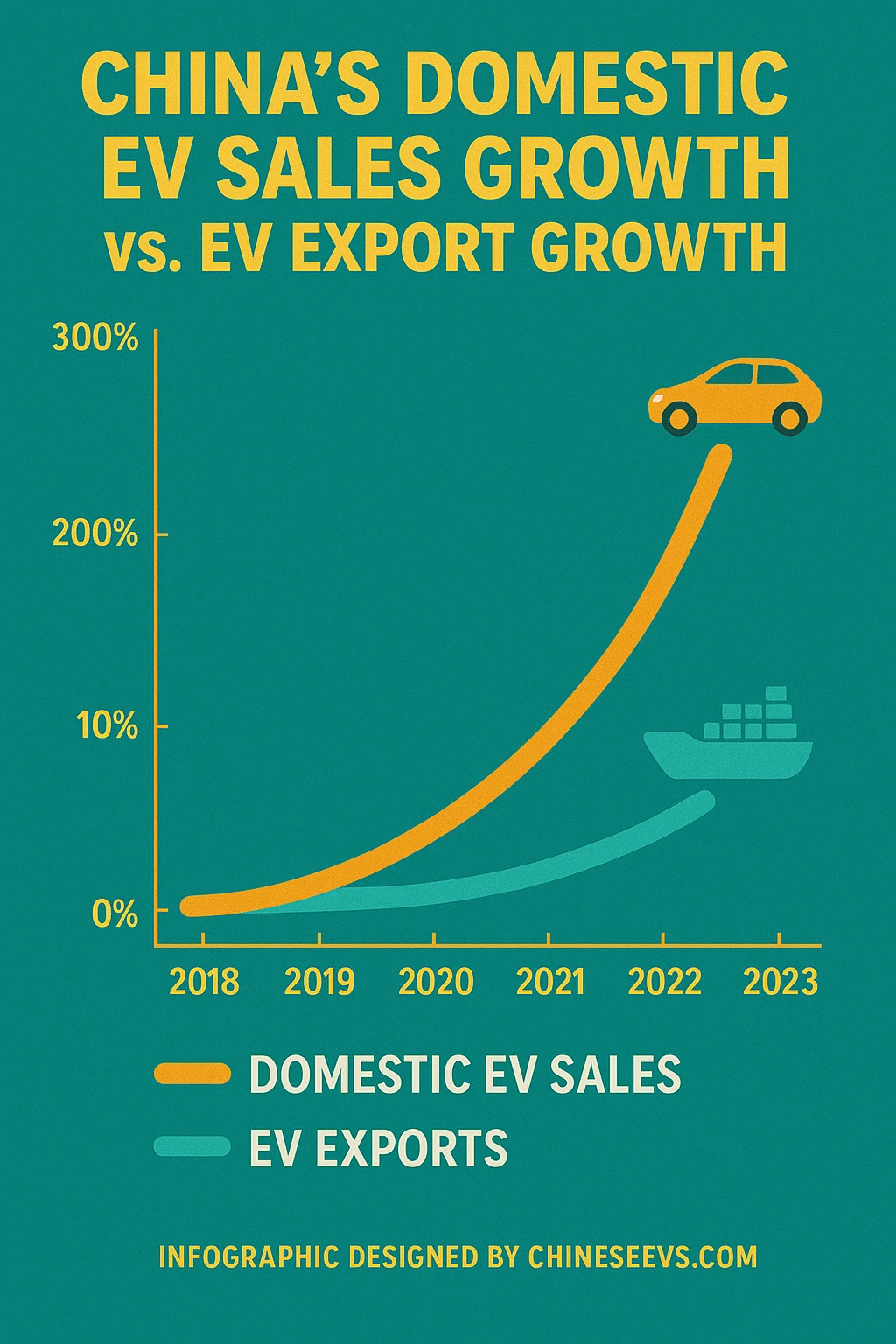
Chinese domestic ev sales growth vs export growth
4. Impact on the Global Automotive Landscape
The global expansion of Chinese EVs is sending ripples throughout the entire automotive world, leading to several significant shifts.
Increased Competition for Legacy Automakers
Established automakers from Europe, Japan, South Korea, and the US are facing unprecedented competition, especially in the EV segment. Chinese brands are often quicker to market with new technologies and can offer more features at comparable or lower prices, forcing legacy players to accelerate their own EV development and re-evaluate their pricing strategies.
Accelerating EV Adoption Worldwide
The availability of more affordable and technologically advanced EVs from China is helping to drive overall EV adoption rates globally, particularly in emerging markets where price sensitivity is high. This contributes to global efforts to reduce transport emissions.
Driving Down EV Prices and Democratizing Technology?
The influx of competitive Chinese EVs is putting downward pressure on EV prices globally. Features that were once confined to premium segments (like large touchscreens, comprehensive ADAS, and long-range batteries) are becoming more mainstream thanks to the value proposition offered by many Chinese models.
Shifting Perceptions of Chinese Manufacturing and Innovation
Successful global expansion is helping to change outdated perceptions of Chinese products. Today’s Chinese EVs are often lauded for their design, build quality, innovative technology, and user experience, showcasing China’s rise as an automotive and technological powerhouse.
5. The Road Ahead: Challenges and Opportunities for Chinese EVs Abroad
While the momentum is strong, the path to sustained global success for Chinese EV brands is not without obstacles.
Overcoming Brand Skepticism and Building Trust
In some markets, particularly those with strong established domestic auto industries, Chinese brands still need to overcome brand skepticism and build long-term trust regarding quality, reliability, data security, and after-sales support. This takes time and consistent positive experiences.
Adapting to Diverse Consumer Preferences and Regulatory Environments
Consumer tastes, driving conditions, and regulatory requirements vary significantly across the globe. Continuously adapting products and services to meet these diverse local needs will be crucial for sustained success.
The Long-Term Sustainability of Rapid Expansion
Rapid global expansion requires significant capital investment, complex logistical operations, and robust management. Ensuring financial sustainability and maintaining quality control across diverse international operations will be an ongoing challenge.
Potential for New Market Entries and Further Disruption
The global EV stage is set for even more players. While some of the current “startup” generation in China face consolidation pressures, new entrants with strong backing (like Xiaomi) are already making their mark domestically and eyeing future international plays. Tech companies collaborating with automakers (like Huawei) will also continue to be a disruptive force.
Conclusion: A New World Order in Electric Mobility, Led by China
The global expansion of Chinese EV brands in 2025 is far more than a fleeting trend; it signifies the emergence of a new world order in electric mobility. Armed with cutting-edge technology, compelling designs, competitive pricing, and unwavering ambition, these companies are not just entering international markets – they are actively reshaping them. While challenges related to trade, brand perception, and operational complexity remain, the sheer scale of innovation and manufacturing prowess emanating from China’s EV sector ensures its influence will only continue to grow. For consumers worldwide, this translates to more choice, better value, and faster adoption of electric vehicles, heralding an exciting and transformative era for personal transportation.
Reader Takeaways
- For Global Consumers: Keep an open mind and research the Chinese EV brands officially launching in your market. You might find they offer a compelling package of technology, features, and value that rivals or surpasses established players. Pay close attention to local reviews and warranty/service provisions.
- For Industry Players (Legacy Automakers & Suppliers): The speed and competitiveness of Chinese EV brands are the new benchmark. Accelerating innovation, optimizing supply chains, and delivering compelling value are no longer optional but essential for survival and growth.
- For Policymakers: The rise of Chinese EVs presents both opportunities (faster EV adoption, increased competition) and challenges (trade balances, local industry impact). Policies will need to adapt to this new global dynamic, fostering fair competition while encouraging sustainable transport.
- For Australian Consumers: The Australian EV market is a key target for many of these expanding Chinese brands like BYD, MG, GWM, Chery, and soon Zeekr. This means more choice and potentially more affordable EVs. Look for models with good ANCAP safety ratings and established local dealer/service networks.
Further Reading (coming soon)
- Deep Dive: The Battery Technology Powering China’s EV Dominance
- Navigating the Maze: Understanding Tariffs and Trade in the Global EV Market
- Head-to-Head: How [Specific Chinese Export Model] Stacks Up Against [Key International Competitor] in 2025
- The Future of In-Car Tech: Are Chinese EVs Leading the Smart Revolution?